
-
Je winkelmandje is leeg
Ga naar de shop om producten in je winkelwagen te plaatsen
Raking & Rocking – Not Just for Beginners!
Raking and rocking are two of the fastest lockpick techniques to open a lock without needing to feel the exact feedback of single pin picking. In this article, I explain how the rake and rocking techniques work, which rakes (S-rake, City rake, Bogota) are best suited for which type of lock, and how security pins can frustrate these techniques.
Author: Ties
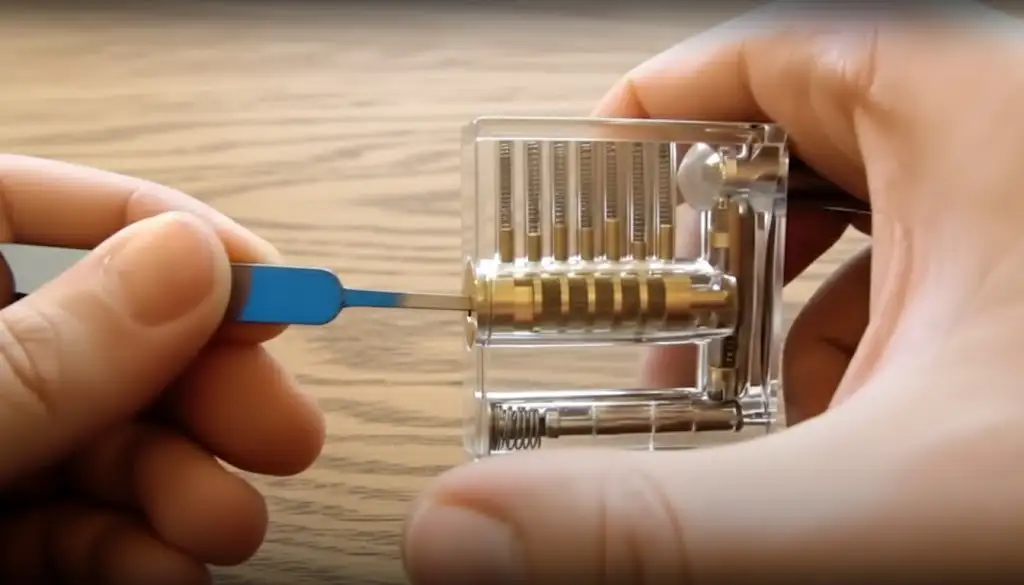
Lockpicking technique Raking opens locks faster than Single Pin Picking, which is great for your confidence.
You can learn the technique quickly and easily, providing you with a fast way to open many locks. Raking is one of the simplest methods of lockpicking for a reason.
If you have any idea how to use a tension wrench, then you have already mastered the hardest part. With a little tension and some shaking, wiggling, and vibrations from the rake lockpick, you can make the lock think that the key is in it.
Every beginner can open locks with this lockpick technique and can grow into a true professional!
A technique for beginners?
Raking is often popular among novice lockpickers who are not yet able to feel the exact feedback from the lock that is necessary for single pin picking. This way, they are still able to open their first locks.
This technique is therefore primarily known as a technique for beginners. Beginners often perform this lockpick technique well without realizing what they are actually doing. However, mastering the raking technique does require a lot of practice. Once you master this technique, it can be a very effective and quick way to open a lock.
Although it is very good for confidence to open the first lock without a key, there is indeed a fine technique involved in raking. Therefore, we will explain what the right raking tools, turning techniques, and lockpick movements are to hit effectively.
You may wonder why raking is not the most popular lockpick technique in the world. If raking is really that simple, then no lock would be safe anymore. That is also what lock manufacturers have taken into account with newer locks. Unlike the Single Pin Pick technique, not every lock is now sensitive to the rake technique. On the other hand, some locks will indeed succumb to this form of lockpicking!
The Rake technique
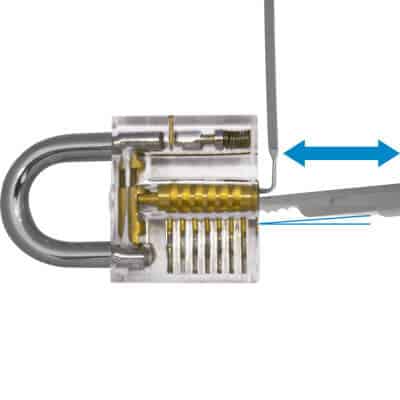
As explained earlier, raking is a technique where you have to rake, but also wiggle a bit. The principle of this technique is to position each pin without needing to pay attention to each pin individually. Raking is handy because it can place multiple pins above the shear line at the same time.
Now that you know this, you understand the advantages of raking, namely speed. There are many different types of lockpicks (or rakes) that you can use, each with its own kind of technique. It can be beneficial for your lockpicking skills to test each rake at least once.
Rocking technique
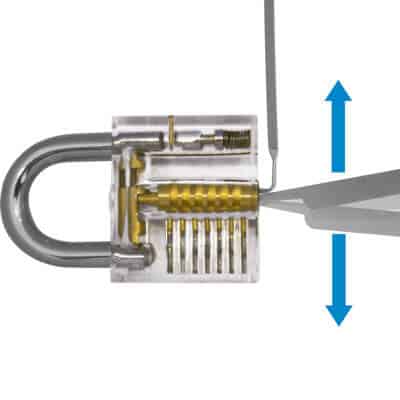
One of the lockpick techniques you may have heard of is the rocking technique.
With this technique, you actually simulate the motion of a rocking chair, moving the lockpick up and down.
A good rake for this technique is the City Rake or the L-Rake. Make sure the tip of the lockpick reaches the back of the lock.
Try to get the last pin in the lock under the last notch of the rake and start wiggling. With this technique, you can introduce a bit more variation into the rake technique.
Finding the shear line
With lockpicking, you are continuously working to place each pin stack at the shear line. This is the physical line that runs between the cylinder core and the housing.
Most locks consist of five or six stacks of pins placed in a row. These stacks usually consist of two pins: the key pin and the driver pin. A spring pushes this stack upwards.
The driver pin is the pin that blocks the rotation of the cylinder core.
With lockpicking, you try to keep the key pin in the cylinder core and push the driver pin into the housing. This way, you effectively break the stack of pins at the shear line.
The scientific principles behind raking
Raking is not a random movement – it is based on Newton’s laws of motion and conservation of momentum. The technique works by creating controlled oscillations that move the pins according to predictable physical principles.
Scientific research with stroboscopic analysis shows that the optimal oscillation frequency is 8Hz with a stroke of about 3mm (⅛ inch). At this frequency, the pins effectively slide into the “wave troughs” without crossing multiple “wave crests”, maximizing the chance of successful setting.
The physics of pin movement:
F = ma (Force = mass × acceleration)
The force exerted by the rake must overcome the spring resistance:
F_rake > F_spring + F_friction
Where F_spring is typically 0.5-2N for standard locks
Material science also plays a crucial role. 301 stainless steel is superior to carbon steel due to its higher tensile strength (1400 MPa vs 400-700 MPa). This means that the rake maintains its shape under stress and provides consistent feedback during use.
Different raking techniques and patterns
In addition to the basic raking and rocking techniques, there are various advanced patterns that professionals use:
1. Scrubbing Technique
A quick back-and-forth motion as if you are scrubbing something clean. Ideal for locks with uniform pin heights.
Typical duration: 3-5 seconds
2. Zipping Technique
A quick, single outward motion – like opening a zipper. Works excellently on cheap locks with loose tolerances.
Typical duration: 1-2 seconds
3. Bitch Picking (Oversetting)
Deliberately applying too much pressure to overset pins, then reducing tension. Effective against locks with weak spring tension.
Typical duration: 5-10 seconds
4. Vibration Technique
Creating subtle vibrations by lightly tapping the rake. Utilizes the resonance frequency of the lock for pin movement.
Typical duration: 10-15 seconds
Professional Raking Demonstration
Check out this comprehensive tutorial from Sparrows on various raking techniques:
Snake rakes or S-rakes
These lockpicks are named after the shape of the head. It will likely be clear to everyone that the top of this rake resembles an S or a snake. This rake lockpick is one of the most popular rakes among rake enthusiasts.

Generally, S-rakes use a kind of scratching, yet raking motion to position the driver pins.
City rake or L-rake
Due to the varying heights along the long length of the head, the head of the City rake resembles the silhouette of a city in the distance. Because of the almost saw-like shape of these rakes, these lockpicks can also be somewhat damaging to the key pins in the lock. The heights and depths of the teeth on the city rake, on the other hand, should resemble the shape of a key.

If you want to use the City rake effectively, you will need to wiggle the rake from front to back while raking in and out of the keyhole. Apply subtle tension with the tension wrench during this process.
Bogota rakes
The story behind these rakes is quite funny and interesting. There are many different lockpicks whose designer and story are unknown, but not for the Bogota rake.

The Bogota lockpicks were designed by Ray Conners, also known as raimundo on the Lockpicking101 forum. The peaks and valleys of these rakes are based on the peaks and valleys of the mountains surrounding the capital Bogota. Ray still makes these lockpicks himself and occasionally sells them online, but he has also provided instructions for anyone to make Bogota rakes themselves.
These rakes are so incredibly effective and special that we would like to highlight them in particular. A Bogota lockpick set is available here.
Recommended Bogota Set: The SouthOrd BPXS12 is an excellent choice for those who want to work seriously with Bogota rakes. This set includes multiple variants of the Bogota design, giving you the right rake for different locks.
Technique with Bogota
Ray describes that the best technique for the Bogota rakes can best be described as a “jittery motion.” The idea is that you use the rake as if you have had way too much coffee, no matter how crazy that sounds.
Many hobbyists and professionals find raimundo’s Bogota lockpicks very effective on most pin cylinder locks. Unlike most rakes, these rakes are very effective against locks where the pins have a lot of height differences.
Pro Tip: Wonder Waves by Christina Palmer
A special mention goes to the Palmer Wicked Waves, developed by Christina Palmer of Elvencraft in collaboration with Sparrows. These innovative rakes combine multiple wave patterns into one pick, making them exceptionally effective against a wide range of locks. The variations in .015″, .020″, and .025″ thicknesses offer flexibility for different keyways.
Security pins and their effect on raking
Note: Security pins are specifically designed to frustrate raking techniques. Recognizing these pins is essential for success.
Modern locks often contain security pins that complicate raking:
| Pin Type | Effect on Raking | Recognition | Solution |
|---|---|---|---|
| Spool Pins | Create false sets through counter-rotation | Cylinder rotates back under too much pressure | Reduce tension, use slower movement |
| Serrated Pins | Generate multiple false clicks | Many small clicks without progress | Combine raking with SPP finish |
| Mushroom Pins | Cause binding when oversetting | Lock feels “stuck” without progress | Reset and use less aggressive technique |
| T-Pins | Block at wrong angle | Irregular resistance | Vary insertion angle during raking |
When does raking work and when does it not?
✅ Raking works WELL on:
- Standard pin tumbler locks without security pins
- Locks with loose tolerances (cheap locks)
- Locks with uniform pin heights
- Master Lock, generic padlocks, basic cylinder locks
- Locks with 4-5 pins (6+ becomes harder)
❌ Raking works POORLY on:
- High-security locks (Mul-T-Lock, Medeco, ASSA)
- Locks with tight tolerances
- Paracentric keyways (curved keyholes)
- Dimple locks and disc detainer locks
- Locks with multiple types of security pins
Practical tips for beginners
The #1 mistake: Too much tension! 80% of failed raking attempts are due to improper tension control. The right tension feels like typing on a keyboard – light but noticeable.
Step-by-step raking process:
Total time: 2-5 minutes per lock
Step 1: Tool selectionChoose the right rake for the lock. Start with a Triple Peak or City Rake for general use.
Step 2: Tension wrench placementPlace the tension wrench at the bottom of the keyway. Use light pressure – similar to pressing an elevator button.
Step 3: Rake insertionInsert the rake fully into the lock until you hit the back. Lift slightly to touch all the pins.
Step 4: Start movementBegin with an in-and-out motion combined with up-and-down wiggling. Maintain a rhythm of about 2-3 cycles per second.
Step 5: Listen and feelPay attention to clicks and changes in resistance. In case of a false set, reduce tension and continue raking.
Step 6: Vary techniqueIf the lock does not open within 30 seconds, try a different rake or technique. Alternate between scrubbing, rocking, and zipping.
Common mistakes in raking
Mistake 1: Too aggressive movements
Beginners often use too much force and speed. This can break picks and damage pins.
Solution: Start slowly and gradually build up speed. The movement should remain controlled.
Mistake 2: Wrong rake for the lock
Not every rake works on every lock. A rake that is too large in a narrow keyway causes binding.
Solution: Invest in different rake profiles. The Sparrows Dark Shift set offers a good variety.
Mistake 3: Giving up after 10 seconds
Raking can sometimes take 1-2 minutes, especially with more complex locks.
Solution: Give yourself at least 60 seconds per technique before switching.
Dutch legislation and lockpicking
Good news: Lockpicking is completely legal in the Netherlands! Owning lockpick sets does not require a permit, and use on your own locks or with explicit permission is allowed.
Important legal points:
- Practicing at home: 100% legal on your own locks
- With permission: Legal on others’ locks with written permission
- APV Article 2:44: Note! Some municipalities prohibit the transport of lockpick tools in public places (fine €140)
- Associations: Being a member of a lockpick association provides extra legitimacy
Warning: NEVER use lockpick tools for illegal purposes. This can lead to criminal prosecution for burglary or attempted burglary.
The Netherlands has a progressive stance compared to countries like the UK, where even the possession of lockpick tools without good reason is punishable. This legal space has led to a thriving lockpick community in the Netherlands.
Professional applications of raking
Raking is not just a hobby technique. Professionals in various sectors use this technique daily:
Police and Justice
- Execution of search warrants in the absence of a suspect
- Welfare checks when concerned about someone’s well-being
- Access to evidence in locked spaces
EOD (Explosive Ordnance Disposal)
- Quick area sweeps for VIP events
- Access to suspicious containers without damage
- Non-destructive entry during bomb threats
Firefighters and Emergency Services
- Access during medical emergencies
- Evacuation of buildings
- Control of vacant properties
These professional applications underscore the importance of proper training and the right tools.
The best tools for raking
Top 5 Rake Picks for beginners:
1. Sparrows Triple Peak
Price: €4.99. Why: Versatile, works on 70% of standard locks. 5/5
2. Sparrows Worm Rake
Price: €4.99. Why: Excellent for locks with varied pin heights. 5/5
3. Sparrows Octo Rake
Price: €5.99. Why: Unique 8-point design for maximum pin contact. 4.67/5
Complete Rake Sets:
For beginners who want to seriously start raking, we recommend the Sparrows Dark Shift
(€47.50). This set includes various rake profiles plus tension tools, perfect for learning all raking techniques.
Diamond Picks for Raking:
In addition to traditional rakes, diamond picks are also effective for raking, especially the offset hybrid variants:
- Sparrows Offset Hybrid .020″ – €4.99 – Perfect combination of raking and SPP
- Valyrian Euro Offset Hybrid – €5.50 – Specifically for European locks
Recommended practice locks for raking
Beginner Level (Week 1-2)
- Master Lock #3: The classic starter lock – €8-12
- Master Lock 140: 4 pins, single spool – €10-15
- Transparent Practice Lock: Visual feedback – €24.99
Intermediate Level (Week 3-8)
- ABUS 54TI/50: German quality with security pins
- Kwikset KW1: American standard
- Radial Lock: Dutch standard
Advanced Level (2+ months)
- ABUS 72/40: Multiple security pins
- ABUS EC75: High-security with tight tolerances
Frequently asked questions about raking
How much tension should I use when raking?
The ideal tension is similar to pressing a keyboard key – about 50-100 grams of force. Too much tension is the most common mistake.
Why doesn’t raking work on my lock while I can SPP?
Raking and Single Pin Picking are different skills. Some locks with security pins or tight tolerances respond poorly to raking.
How long should I try before switching techniques?
Give each technique at least 60-90 seconds. Then switch between scrubbing, rocking, and zipping.
Which rake is best for beginners?
The Triple Peak rake is ideal for beginners due to its versatility. It works on about 70% of standard pin tumbler locks.
Can I damage my lock with raking?
With proper use of quality tools, damage is minimal. Never use excessive force.
Does raking work on all locks?
No, raking works best on standard pin tumbler locks without security pins. High-security locks are largely immune.
What is the difference between raking and bumping?
Raking uses a special pick to manipulate pins, while bumping uses a specially cut key that is “bumped” with a hammer.
I hope this has explained the rake technique and rakes a little bit. Feel free to contact us and ask your question, we often respond within minutes.

More Lockpicking Blogs
Want to learn lockpicking? With the right lockpick set and our guides, you can open your first lock within just a few hours. Whether you choose a beginner lockpicking set or professional lockpick tools, our articles will teach you all the techniques step by step.
How can you improve in lockpicking?
Do you want to become faster and better at lockpicking? With these 6 practical tips, you'll learn why you should vary between locks, how to prevent frustration, why regular...
Making a Key Yourself with the Lishi Tool in 5 Steps
Lost your key and no locksmith at hand? Learn in 5 steps how to make a new key yourself with a Lishi tool using the impressioning technique, suitable for...
Opening a Padlock with a Belt
A simple belt turned out to be enough to open a padlock, as a surprising video shows. This story illustrates how creativity can solve a problem without special tools...
Key Broken in Lock? 5 Methods + Costs [2025]
You turn your key, hear a click, and BAM – you’re left with half in your hand. No!! That was… Read more »