
-
Your shopping cart is empty
Go to the shop to add products to your cart
Knowledge base on Lockpicking
Welcome to the most complete English guide on lockpicking. Whether you are buying a lockpick set for the first time or looking to improve your techniques, you will find all the information you need in this knowledge base.
I have written this guide based on years of experience in the lockpicking world. No vague marketing story, but honest information about what works, what doesn’t work, and how to best start with this fascinating hobby.
What is lockpicking?
Lockpicking is the art of opening locks without using the original key. It may sound like something for burglars, but nothing could be further from the truth. Lockpicking is a legitimate hobby practiced by hundreds of thousands of enthusiasts worldwide. This hobby is also known as locksport.
In lockpicking, you use specialized tools to manipulate the mechanisms inside a lock. You are essentially simulating what a key does, but pin by pin. It requires patience, feel, and an understanding of how locks work.
Why do people start lockpicking?
The reasons for starting lockpicking are diverse. Some find it fascinating to understand how locks work. Others enjoy the puzzle-like challenge. And some see it as a useful skill for emergencies.
What I personally love most about lockpicking: it is a skill you can take anywhere. A small set of lockpicks fits in your pocket, and the techniques you learn are never forgotten. Plus, there is something immensely satisfying about the moment a lock clicks open after struggling with it for five minutes.
Want to dive deeper into the basics? Read how lockpicking works for a detailed explanation of the mechanisms.
Ready to get started? Check out our complete collection of lockpick sets or jump straight to the beginner lockpick sets.
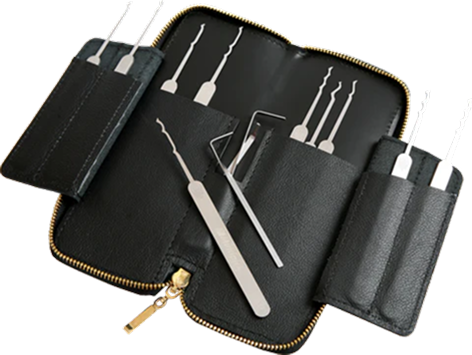
Choosing your first lockpick set
This may be the most important decision you make as a beginner. A good lockpick set can make the difference between frustration and success. But with so many options on the market, how do you choose the right one?
What should a good beginner set include?
A beginner set doesn’t need to be large. In fact, too many picks can be overwhelming at first. What you need:
Essential picks: A set with 5-15 picks is ideal for beginners. You will need at least: a short hook, a medium hook, a snake rake or city rake, and a diamond pick. These four basic picks cover 90% of the locks you will encounter as a beginner.
Tension wrenches: This component is often underestimated, but good tension wrenches are crucial. You need both bottom-of-keyway (BOK) and top-of-keyway (TOK) wrenches. Without proper tension on the lock, you won’t get anywhere.
Material and thickness: For European locks, you want picks that are 0.6mm or thinner. American locks often have wider keyways, so you can use thicker picks there. Most Dutch locks require thinner picks, so pay close attention to this when making your choice.
My recommendations for beginners
After testing dozens of sets over the years, here are the options I recommend:
For the absolute beginner who doesn’t want to spend too much, the LPXS15 lockpick set with practice lock is an excellent choice. You get picks, tension wrenches, and a transparent practice lock to start with. Everything you need in one package.
Want something of higher quality? The Sparrows Kick Start set is one of the best entry-level sets available. Sparrows is known for quality tools that last for years.
Looking for a complete starter package with instructions? Check out the Lockpicking Starter Deal. This includes everything to get started right away.
For a more extensive comparison of sets, read my review of the 6 best lockpick sets or my advice for your first set.
Tip: Don’t buy the cheapest set you can find. Bad picks are frustrating to work with and can even damage your locks. Invest a little more in quality that will last for years.
Practice locks: where to start?
A lockpick set without a practice lock is like a guitar without strings. You can’t do much with it. Practice locks are specially designed to learn lockpicking, and they make the learning process much more enjoyable.
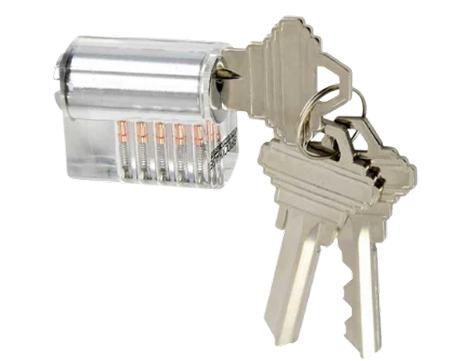
Transparent practice locks
For absolute beginners, I always recommend a transparent practice lock. These locks have a clear casing that allows you to see exactly what is happening inside while you practice.
You can see how the pins move when you insert your pick, how the shear line works, and what happens when you apply tension with your tension wrench. This visual aspect greatly accelerates the learning process. What normally takes weeks to feel, you can understand in just a few hours.
There are different variants available: transparent locks with spool pins for when you want to learn about security pins, and standard versions for the basics.
Progressive practice with real locks
After the transparent locks, it’s time for real metal locks. The best approach is progressive: start with simple locks and gradually work your way up to more complex variants.
Level 1 – Basic: Start with simple padlocks with 4-5 standard pins. The padlocks in our collection are perfect for this.
Level 2 – More challenging: Move on to cylinder locks with standard pins. These are slightly more difficult due to their different shape and the fact that you have to hold them or clamp them in a vise.
Level 3 – Security pins: Locks with spool pins, serrated pins, or other security pins. These provide false feedback and require a different technique.
Level 4 – High security: Locks from brands like ABUS with advanced security features. ABUS locks are excellent for taking your skills to the next level.
Want to learn how to set up your own practice locks with different pin combinations? Read my guide on setting up practice locks.
Practice lock packages
Don’t know where to start? There are ready-made practice lock packages available with locks of varying difficulty levels. This way, you don’t have to figure out which locks correspond to which level yourself.
Basic lockpicking techniques
There are two main techniques that every lockpicker should know: single pin picking (SPP) and raking. Both have their place, and a good lockpicker masters them both.
Single Pin Picking (SPP)
Single pin picking is the technique where you manipulate each pin individually to the shear line. It is more precise than raking and works on almost all pin tumbler locks, including those with security pins.
The basics of SPP:
Step 1 – Tension: Apply light tension with your tension wrench. The trick is to apply just enough pressure so that the lifted pins stay in place, but not so much that the pins bind.
Step 2 – Find the binding pin: Due to the tension, one pin binds more than the others. This is the pin you need to set first. Feel with your pick which pin offers the most resistance.
Step 3 – Set the pin: Push the binding pin up until you feel or hear a slight click. The cylinder turns a fraction. Now another pin binds.
Step 4 – Repeat: Continue until all pins are set and the lock opens.
Sounds simple? In theory, it is. In practice, it requires hours of practice to develop the feel. But that is precisely what makes lockpicking so satisfying. Read my extensive tips for single pin picking to refine your technique.
Raking
Raking is faster and less precise than SPP. You move a rake pick back and forth through the lock while applying tension. Due to the random movements, pins sometimes jump into the right position.
Raking works best on:
- Cheap locks with poor tolerances
- Locks with standard pins (no security pins)
- Locks you want to open quickly
The most popular rakes are the snake rake, city rake, and bogota. Each rake has a different profile that works better on certain locks. Check out the different rake picks to see which ones suit you.
Want to know more about raking? I have written a complete explanation about rakes and the raking technique.
Common mistakes made by beginners
After years of helping beginners, I keep seeing the same mistakes:
Too much tension: This is by far the most common mistake. Too much pressure on the tension wrench causes pins to jam and not move. Always start with minimal tension and gradually increase it.
Wanting to go too fast: Lockpicking is not a race. Take your time to feel and understand each lock. Rushing leads to frustration.
Wrong pick for the lock: Not every pick works on every lock. Experiment with different picks on the same lock to discover what works.
Giving up on security pins: The first time you encounter a lock with spool pins, it may seem impossible. But with the right technique (counter-rotation), they can be managed.
I have gathered all the common mistakes in this article about the 10 most common lockpicking mistakes.
Lockpick tools explained
Let’s dive deeper into the different types of tools you use as a lockpicker.
Picks: the basics
A lockpick is the tool you use to manipulate the pins in a lock. There are dozens of different shapes, each with its own applications.
Hooks: The most versatile picks. There are different hook picks available, from short hooks for deep keyways to steep hooks for high pins. A good hook is essential for single pin picking.
Rakes: Designed for quick opening through movement. Rake picks have a wavy or serrated profile. Popular variants include the snake, city rake, and bogota.
Diamonds: Diamond picks have a diamond-shaped tip. They are handy for setting individual pins and work well in narrow keyways.
Ball picks: Ball picks have a round end. They are mainly used for wafer locks and some automotive locks.
Tension wrenches: the underrated tool
The tension wrench is just as important as your picks. Without the right tension, no lock will open.
Bottom of keyway (BOK): These wrenches sit at the bottom of the keyway. They provide a lot of control but take up space for your pick. Ideal for larger keyways.
Top of keyway (TOK): These sit at the top of the keyway, giving you more space for your pick. Essential for narrow European locks.
Feather tension: Special wrenches that automatically provide the right pressure. Perfect for beginners who still need to learn how much tension is needed.
A good collection of tension wrenches in different thicknesses is indispensable. Many beginners underestimate this and work for months with one unsuitable wrench while the lock simply cannot be opened with that setup.
Additional tools
In addition to picks and tension wrenches, there are more tools that can be handy:
Plug followers: If you want to disassemble locks to practice or repin, you need a plug follower. This tool keeps the pins in place while you remove the cylinder.
Pinning kits: Want to assemble your own practice locks? With pinning tweezers and loose pins, you can customize locks.
Vices: A vice is essential if you want to practice on cylinder locks. You need both hands for picking, so the lock must be secured somewhere.
Advanced tools and techniques
Once you master the basics, a world of advanced possibilities opens up.
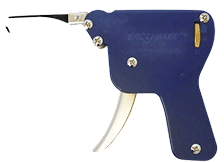
Lockpick guns
A lockpick gun (also known as a snap gun) is a mechanical or electric device that strikes all pins up at once. Due to the vibration, pins sometimes jump to the shear line.
There are manual lockpick guns that you activate with a trigger, and electric lockpick guns that do the work for you.
Lockpick guns are not a miracle solution. They work well on simple locks but often fail on locks with security pins or tight tolerances. Still, they are a handy addition to your tools.
Curious about the differences? Read my comparison between lockpick guns and traditional sets.
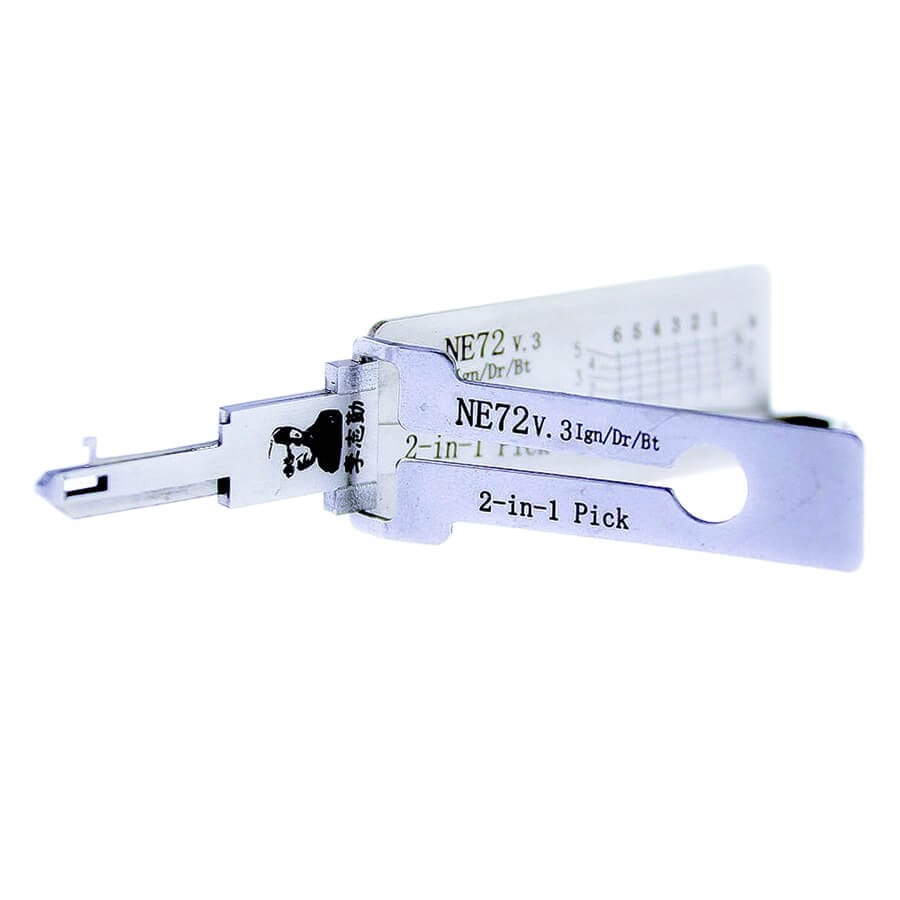
Lishi 2-in-1 tools
For automotive locks and specific locking systems, there are Lishi tools. These 2-in-1 tools combine a pick and decoder in one instrument. You can not only open the lock with them but also read the code to create a key.
Lishi tools are specific to each lock type. There are versions for car brands such as Lishi HU66 for VAG vehicles, but also for padlocks like Lishi AM5 for American Lock and Lishi KW5 for Kwikset.
Want to learn how to work with Lishi tools? I have written a guide on opening automotive locks with Lishi 2-in-1 tools.
Bypass tools
Sometimes you don’t need to pick a lock at all. Bypass tools completely circumvent the locking mechanism.
Shimming: With shims, you can open some padlocks by unlocking the shackle without manipulating the lock itself.
Decoders: Decoders are used to determine the code of combination locks.
Flipper cards: Flipper cards are thin, flexible cards that allow you to open lever-type locks by pushing back the latch bolt.
Skeleton keys: Skeleton keys (runners) work on older warded and lever locks.
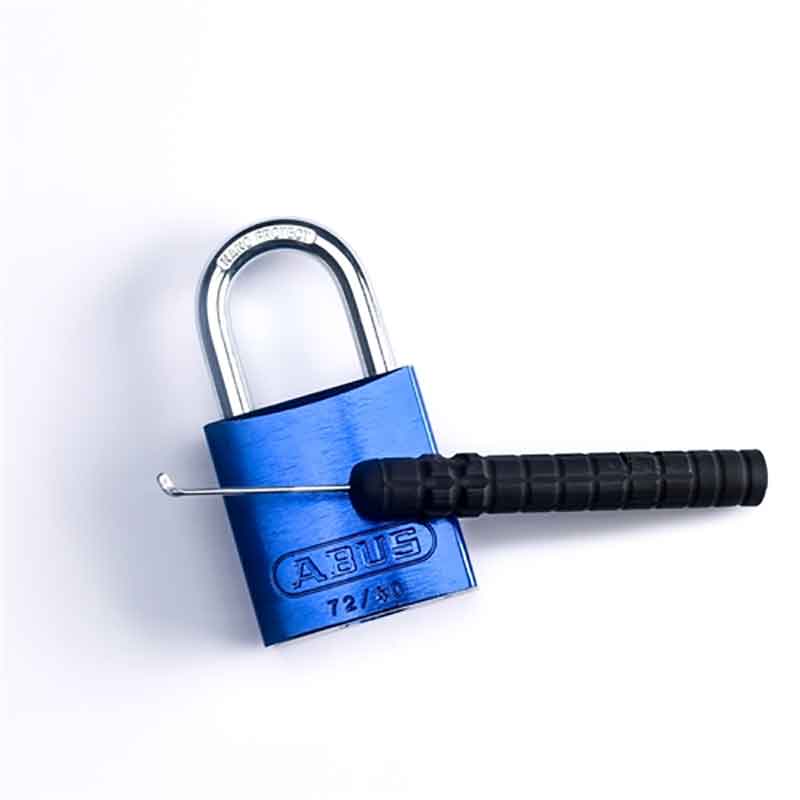
Dimple picks and disc detainer picks
Not all locks are pin tumbler locks. There are also other mechanisms that require specialized tools.
Dimple locks: These locks have pins that come from the side instead of from above. You need special dimple pick sets to open them. Dimple locks are popular in Asia and are increasingly seen in Europe.
Disc detainer locks: Locks with rotating discs instead of pins. The disc detainer pick is a specialized instrument for opening these locks.
Tubular locks: The round locks you often see on vending machines and safes. Tubular lockpicks are specifically designed for this type of lock.
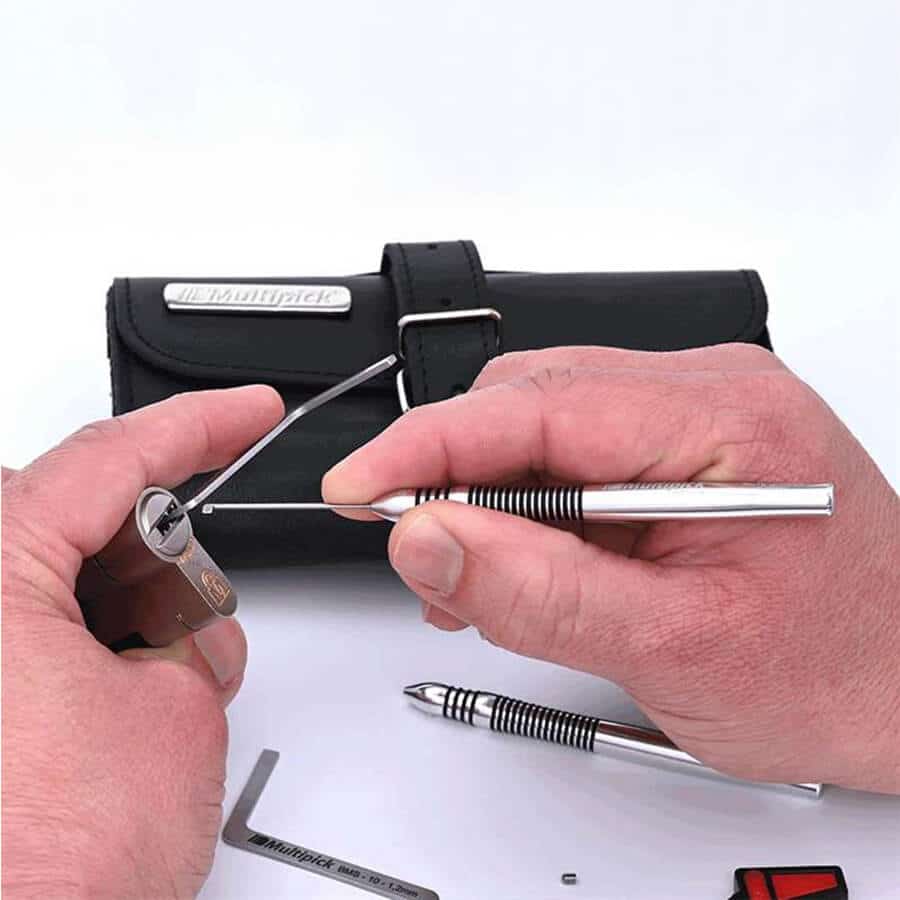
Bump keys
Bump keys are specially filed keys that you can use to open pin tumbler locks by a bumping motion. It is a technique that requires little skill but does need the right key profile.
Want to know more about bumping? Read my article on lockpicking and bumping.
Is lockpicking legal in the Netherlands?
This is a question I often get, and rightly so. The possession and use of lockpicks falls into a gray area that varies by country.
The Dutch situation
In the Netherlands, the possession of lockpicks is not explicitly prohibited. You may buy, own, and use them, as long as you do not use them for illegal purposes. This is similar to the possession of a crowbar: the tool itself is legal, but committing burglary is not.
The key is intent. If you possess lockpicks for hobby purposes, as a locksmith, or for security research, there is nothing wrong. If you use them to break in? Then you are liable for the burglary, not for the possession of the picks.
However, there are nuances:
- Public space: If you are stopped with lockpicks in combination with other suspicious tools or behavior, this can be seen as preparation for burglary.
- Professional use: Locksmiths often need to demonstrate that they are professionally active.
Other countries
The law varies by country. In Germany, the United Kingdom, and most EU countries, the situation is similar to the Netherlands. In some U.S. states and Australian territories, the rules are stricter.
Traveling with lockpicks? Always inform yourself in advance about the local legislation.
For a complete explanation of the legal situation, read my article on the legality of lockpick sets.
Important rule: Only practice on your own locks or locks for which you have explicit permission. Never practice on locks that are in use. This is not only a legal issue but also an ethical one.
Next steps and community
Lockpicking is more than just a hobby. There is an active, helpful community you can join.
TOOOL Netherlands
TOOOL Netherlands (The Open Organisation Of Lockpickers) is the Dutch locksport association. They organize meetups where you can meet other lockpickers, exchange locks, and learn from experienced pickers.
The atmosphere at TOOOL is open and welcoming. Everyone is welcome, from absolute beginners to experienced pickers. It’s a great way to improve your skills and meet like-minded people.
Online communities
There are various online places where lockpickers come together:
- Reddit r/lockpicking: An active community with beginner questions, progress posts, and discussions about tools.
- Discord servers: Real-time chat with other pickers from around the world.
- YouTube: Countless channels with tutorials, reviews, and lock opening videos.
Read more about the international community in my article on Lockpickers United.
Belt ranking system
In the lockpicking community, the belt ranking system is often used. Just like in martial arts, you start with a white belt and work your way up by opening increasingly difficult locks.
The system goes from white (beginner) through yellow, orange, green, blue, and purple to red and black (expert). Each level has specific locks you must be able to open to advance.
This system provides structure to your learning process and motivates you to tackle more challenging locks.
Continuous learning
There is always more to learn in lockpicking. New lock types, new techniques, new tools. The hobby remains engaging because you are never done learning.
Some suggestions to continue:
- Specialize in a specific type of lock (dimple locks, disc detainers, automotive)
- Learn to disassemble locks and understand how they work
- Create your own challenge locks with difficult pin combinations
- Help other beginners and share your knowledge
A great book to learn more is “The Visual Guide to Lock Picking” by Mark McCloud, available in our collection of lockpicking books.
Getting started
You now have all the information you need to start lockpicking. Theory is important, but ultimately you learn the most by practicing.
My advice: start small. Buy a decent beginner set, a transparent practice lock, and get to work. Don’t expect to open locks within an hour. Give yourself time to develop the feel.
And remember: every lock you can’t open is not a failure. It’s a learning moment. Even the best lockpickers struggle with locks for a long time. That’s what makes the hobby so fascinating.
Start lockpicking today
Check out our complete collection of lockpick sets or get started right away with the popular LPXS15 set with practice lock.
Check out our complete collection of lockpick sets or get started right away with the popular LPXS15 set with practice lock.
Frequently asked questions about lockpicking
What is the difference between lockpicking and locksport?
Locksport is the hobby practice of lockpicking. It emphasizes that it is a legitimate hobby, similar to puzzling or chess. Lockpicking is the skill itself, which is also used by locksmiths and security researchers.
Will I damage my lock by practicing?
With the right tools and the correct technique, no. Cheap picks or picking too aggressively can cause damage. This is a reason to invest in quality tools and always start on practice locks, not on locks that you actually use.
Can I pick all locks?
No. High security locks from brands like Abloy, Medeco, and EVVA are designed to resist picking. They are not impossible to open, but require exceptional skill, special tools, and a lot of time. For hobby lockpickers, these are long-term challenges.
Which brand of lockpicks is the best?
Can I lock myself out and then pick my door open?
In theory, yes, but in practice, I advise against it. Under stress, in poor lighting, and without your usual setup, picking is much more difficult. Moreover, most front doors are equipped with locks that are significantly harder than practice locks. In emergencies, call a locksmith.
How long does it take to learn lockpicking?
You can open your first transparent practice lock within an hour. A really simple lock can be opened within a week of regular practice. Developing real skill? That takes months to years, depending on how much you practice and which locks you want to open.
This knowledge base is regularly updated with new information. Do you have questions that are not answered here? Feel free to contact us.
Last updated: December 2025