
-
Je winkelmandje is leeg
Ga naar de shop om producten in je winkelwagen te plaatsen
Open radial lock with lockpicks
Radial locks, or tubular locks, may look complicated but are actually very easy to lockpick with the right tubular lockpick. Discover how this round lock is constructed, what tools you need, and how to open a radial lock step by step.
Author: Ties
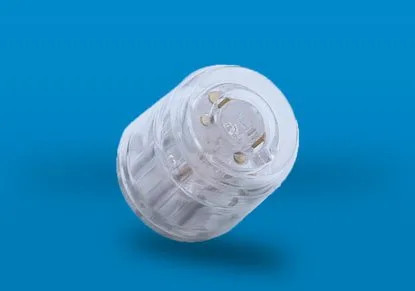
Radial locks or in English Tubular locks, are mainly found in vending machines, slot machines, safes, cable locks, and countless other public facilities. From a lockpicker’s perspective, one might wonder why someone would still choose to secure something with a radial lock.
The radial lock uses the same locking mechanism as other pin cylinder locks, such as the cylinder lock and many different padlocks. However, there is a very simple way to open the radial lock with special tubular lockpicks.
We will explain how to open a radial lock with lockpicks.
The components of a radial lock
The transparent radial lock perfectly illustrates how the lock functions. The lock consists of several layers, allowing it to work lengthwise, unlike other pin cylinder locks.
Do not be misled by the unusual shape of these locks. They are actually very easy to lockpick once you understand how.
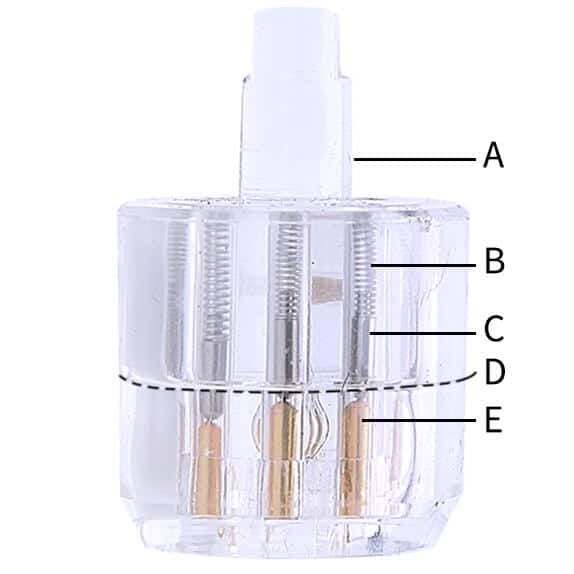
A. Cylinder
B. Spring
C. Lock pin
D. Separator line
E. Key pin
Almost all radial locks have a round housing. This round housing often tapers, allowing it to sit flush against the mounting plate.
Radial locks, like other cylinder locks, have a cylindrical core (A) that allows it to rotate. This core is built like a “t” shaped cross. The horizontal part of the “t” is a round disc where the key and lock pins are located.
The pins (C & E) are evenly distributed along the length axis of the lock. The key pins (E) and part of the lock pins (C) are located in the cylinder core of the radial lock.
In addition to the horizontal part of the cylinder core, there is another component in the radial lock that resembles a revolver magazine. This “magazine” sits just below the horizontal disc of the cylinder core. This component is often held in place by a small screw that is secured through the tailpiece into a small hole.
The revolver magazine contains the springs (B) and the second part of the lock pins (C) of the radial lock. When the lock is not in use, the springs (B) push all the pins towards the front of the lock.
If you want to lockpick the radial lock and open it, you will need to push the pins to different depths. Ultimately, you want the pins to reach the separator line indicated by D in the image above.
Tubular lockpicks
If you want to lockpick these locks, it is often very simple.
The best tool for this is a tubular lockpick. These special lockpicks are often sold as tubular lockpicks, Ace picks, or radial lockpicks.
They are about the same length as a ballpoint pen and the width of a thick marker. There are seven needles around the length axis of the tip that correspond to the pins in the axial lock.
The axial lockpick has a ring that is turned up or down. This ring replaces the tension wrench that you need for other locks to turn the lock.
Tubular lockpicks are specially designed to unlock the mechanism of a radial lock. The tubular lockpick creates perhaps the simplest lockpick method that exists.
Let’s get started:
- Check the lock for dirt and ensure that all pins are easily accessible.
- Turn the ring of the axial lockpick upwards (it does not need to be tightened too much).
- Slide the needles of your axial lockpick back and forth two to three times to ensure they slide well.
- Then slide all the needles all the way forward so they stick out.
- Press the needles against a flat surface (a table) so they align with the tube of your axial lockpick.
- Now that the needles are aligned with the end of the axial lockpick, insert the lockpick all the way to the back of the lock.
- Do NOT insert the lockpick at an angle, as this can confuse the needles of the lockpick.
- With a turning motion, moving the lockpick back and forth in a clockwise and counterclockwise direction, try to move the needles of the tubular lockpick to the correct depths.
- The radial lock should now open.
- Remove the tubular lockpick from the lock and tighten the collar of the pick.
Did you lose the key? Now that the lock is open and the collar of the lockpick is securely tightened, you hold a new key for the radial lock in your hands.
You can use the depths of the needles to create a new key or use the lockpick to easily open the lock from now on.
Manual lockpicking
Single Pin Picking (SPP) works with radial locks in the same way as with other pin cylinder locks. You go around the lock and push each pin in while applying tension with the tension wrench. Also with radial locks, you apply a rotating tension, but it can be difficult to find a good tension wrench. You can try to make your own tension wrench from an Allen key, but you can also buy them from us.
The well-known brand Sparrows has created some tension wrenches specifically designed to apply tension to a radial lock.
Transparent radial locks for learning lockpicking
If you want to learn how to open this round lock, a practice lock is essential. A wise man once said, those who want to be smart must practice. An even wiser man then invented the transparent practice lock to learn lockpicking.
These round locks are made exactly like radial locks. You can clearly see how the pins in the lock move and respond to your lockpicks or the included keys.
You will find radial locks from various brands with standard pins or with special security pins.

More Lockpicking Blogs
Want to learn lockpicking? With the right lockpick set and our guides, you can open your first lock within just a few hours. Whether you choose a beginner lockpicking set or professional lockpick tools, our articles will teach you all the techniques step by step.

May 4th Remembrance Day: The Value of Freedom
On May 4th, we pause to remember the victims of World War II and commemorate the value of freedom. We reflect on the sacrifices made and the importance of...
Opening Locks with Aluminum Foil
Foil impressioning is a clever technique to open high-security dimple locks using only a blank key and aluminum foil. Discover how this method works, why it also works on...

The Unpickable Lock
Are there locks that really can't be picked? We examine the latest attempt by YouTuber Works By Design, along with previous attempts by Stuff Made Here and Andy Pugh....
Setting Up a Practice Lock Yourself
Learn step by step how to create your own lockpicking practice lock from an ABUS 72/40 padlock. From disassembling the cylinder to progressively repinning: this comprehensive guide helps you...