
-
Je winkelmandje is leeg
Ga naar de shop om producten in je winkelwagen te plaatsen
GrimGO Prototype: FEA analysis
A technical research report on the GrimGO prototype phase, in which an FEA analysis (Finite Element Analysis) was conducted on more than 35 lockpick designs. Discover what insights this research provided regarding the strength and durability of the final lockpick set.
Author: Ties
Methodology and test parameters
The FEA analysis was conducted according to standardized parameters to enable comparable measurements between different designs.
Standardized test conditions
- Applied force: 8.9 Newton (2 lbf)
- Contact area: 2mm² at tip
- Resulting pressure: 4.45 MPa
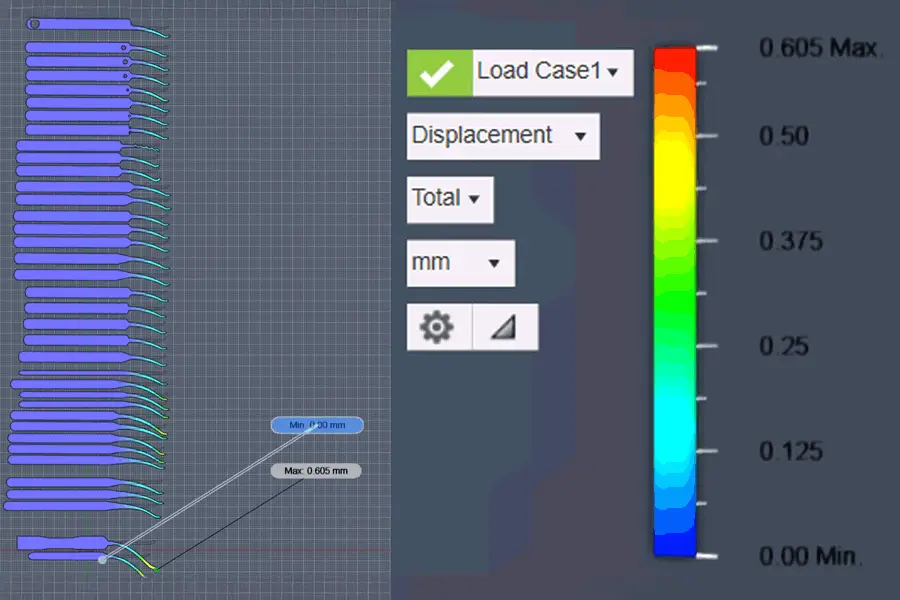
The testing method follows the recommendations from Christina Palmer’s metallurgical research on elvencraft.com. All designs were tested under identical boundary conditions for direct comparability.
Comparative measurement data of existing designs
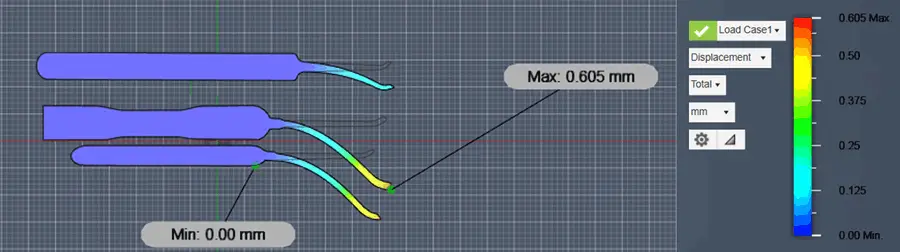
Three designs were selected for direct comparison: the new prototype, the APEX Hook Pick (Covert Instruments, e.g., mcnally lockpicking set, lockpickinglawyer lockpick set), and the Peterson H1. This selection is based on similar geometric profiles.
| Design | Max. deflection (mm) | Relative stiffness | Note |
|---|---|---|---|
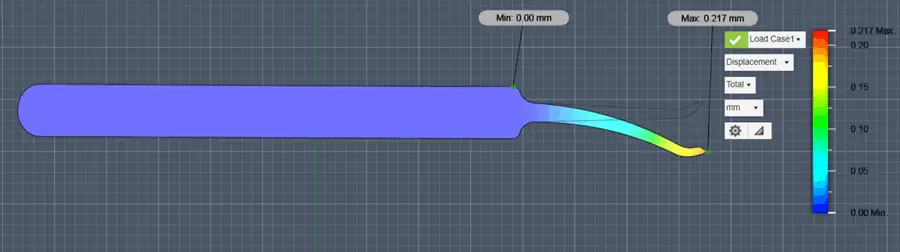
| Prototype | 0.217 | 100% (reference) | 32mm effective shaft |
| APEX Hook | 0.605 | 36% | Longer shaft length |
| Peterson H1 | 0.591 | 37% | Standard profile |
Measurement note: 1. The APEX shows 2.79× more deflection than the prototype. This is primarily attributed to the longer effective shaft length.
2. Covert Instruments is not known to use stainless steel from the 400 series, as Peterson and GrimGo do. In our analysis, we assigned all tools the same material, as we were only concerned with the design.
Prototype specifications and geometry
The prototype incorporates three geometric features that correlate with reduced deflection in the FEA analysis:
- Shortened shaft length: 32mm effective (measured from first support point to tip)
- Progressive taper: Linear reduction of handle thickness to 2mm tip
- Smooth transitions: No abrupt diameter changes in stress zones
Von Mises stress distribution
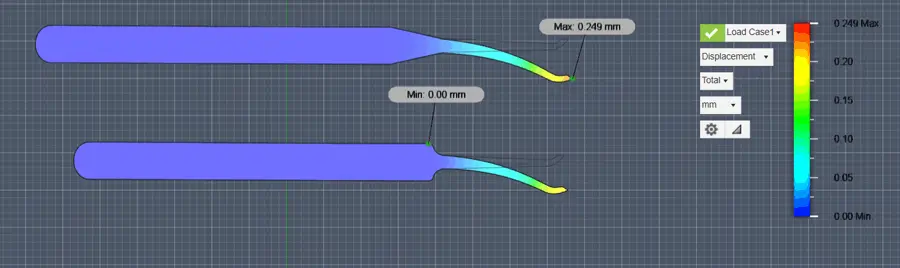
The Von Mises stress analysis identifies potential failure points in the design. This data is relevant for lifespan prediction under cyclic loading.
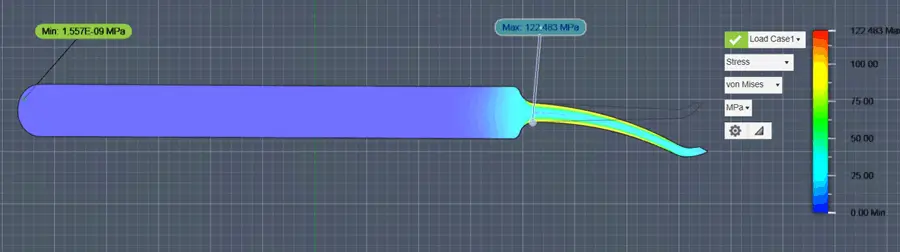
Measured stress values
- Maximum stress: 122.483 MPa (transition zone)
Note: These values are computer simulations. Practical testing must confirm whether the predicted lifespan corresponds with actual use. Factors such as surface finish, micro-cracks, and user technique can significantly deviate from ideal simulation conditions.
410 Stainless Steel properties
The prototype uses 410 stainless steel in 0.5mm thickness. This is a martensitic stainless steel alloy commonly used in medical instruments and precision tools.
| Property | 410 SS (prototype) | 301 Full Hard (reference) | Difference |
|---|---|---|---|
| Yield Strength | 221 ksi (1524 MPa) | 140 ksi (965 MPa) | +58% |
| Hardness (Rockwell C) | 42-52 HRC | ~41 HRC | +2-27% |
| E-modulus | 200 GPa | 193 GPa | +3.6% |
| Density | 7.8 g/cm³ | 7.9 g/cm³ | -1.3% |
The material choice is primarily based on availability in 0.5mm thickness from our supplier. The higher carbon content (0.15% C minimum) allows for heat treatment to achieve higher hardness than austenitic grades.
Early Adopter Testing Program
The prototype is production-ready but unpolished. All picks have visible production markings, inconsistent surface finish, and have not been tested in extensive practical situations.
Prototype Test Program – Conditions
Status: Unpolished prototype, batch 1/1
Available: 100 pieces (4-pick sets)
Price: €15.00
What you get:
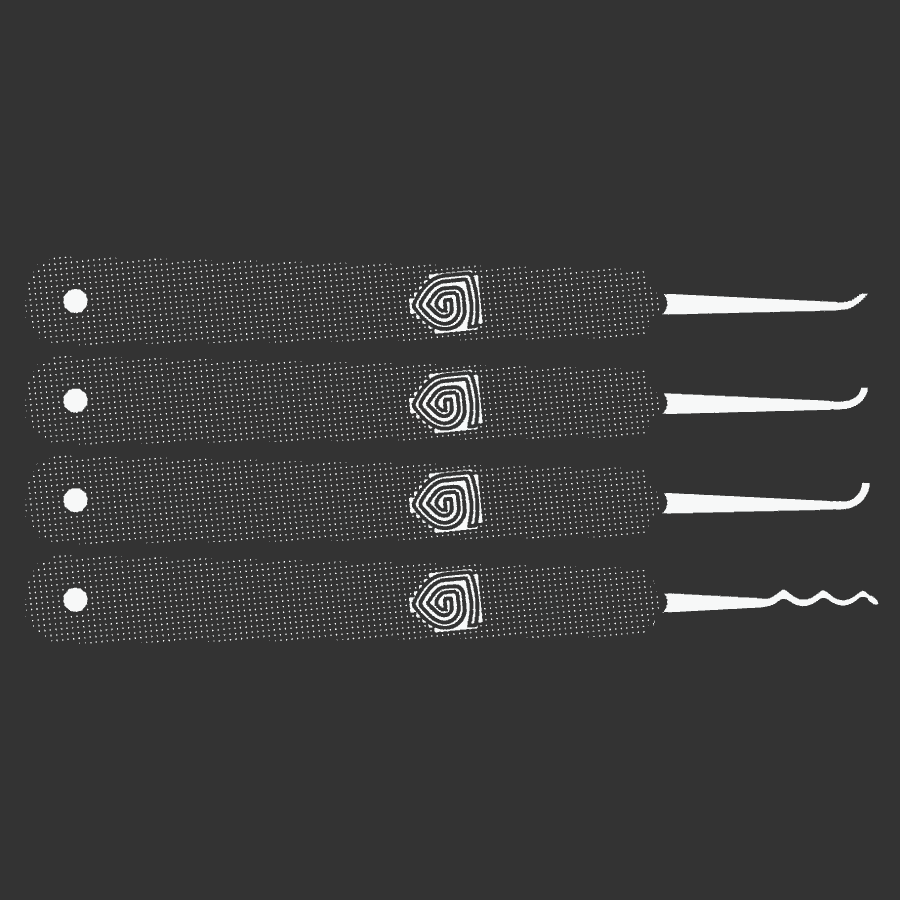
- 1× Standard Hook (0.5mm 410 SS)
- 1× Medium Hook (0.5mm 410 SS)
- 1× Large Hook (0.5mm 410 SS)
- 1× Triple Peak Rake (0.5mm 410 SS)
- 3× TOK Tension Wrenches (standard quality)
- 3× BOK Tension Wrenches (standard quality)
Refund structure:
With the purchase of this prototype, you will receive a discount code worth €15.00. This code is exclusively valid for the final version when it becomes available (expected date: Q1 2026). The code is redeemable once and expires 6 months after the release of the final version.
Practical: You pay €15.00 now for the prototype. When the final version is released (price yet to be determined, estimated €25-35), you can order it and receive a €15.00 discount via the provided code.
Terms and expectations
Read this carefully before purchase
This is a prototype. Expect the following limitations:
- Surface quality: Visible grinding marks, oxidation spots, inconsistent finish
- No warranty: Prototypes do not come with a standard warranty. Defects are assessed on a case-by-case basis
- Geometric variation: ±0.1mm tolerance on critical dimensions possible
- Packaging: Basic plastic bag, no retail packaging
- Documentation: No manual, tutorials, or support material included
- Delivery time: 1 day. Ordered before 23:30 is delivered tomorrow.
Suitable for: Experienced and novice lockpickers who want to provide technical feedback on pick performance. The set is designed for beginner lockpickers, as a first lockpick set.
Feedback method
Early adopters can use a feedback form. This includes specific questions on how to evaluate the set. Feedback is not mandatory but appreciated for design upgrades.
Download the form here:
Download GRIMGO Feedback Survey (311 KB)
Final version expectations
The final version will differ from this prototype in the following aspects:
- Polished surface finish (tumbled)
- Handle option (rubber, heat-shrink, or bare)
- Neat storage folder
- Possible geometry adjustments based on feedback
- Standard warranty terms
Timeline: No fixed date. The final version will be available when:
- At least 50 feedback forms have been received
- Identified design issues have been addressed
- Production process has been validated for consistent quality
Data sources and methodology references
This research is based on the following public sources:
- Christina Palmer – Lock Pick Recommendations (FEA methodology)
- Christina Palmer – Lock Pick Metallurgy (material properties)
- Material datasheets 410 Stainless Steel (various suppliers)
- Standard FEA procedures for cantilever beam analysis
All measurements are solely simulation data. Practical tests are ongoing but not yet in sufficient quantity for statistical analysis.
Related technical articles

More Lockpicking Blogs
Want to learn lockpicking? With the right lockpick set and our guides, you can open your first lock within just a few hours. Whether you choose a beginner lockpicking set or professional lockpick tools, our articles will teach you all the techniques step by step.
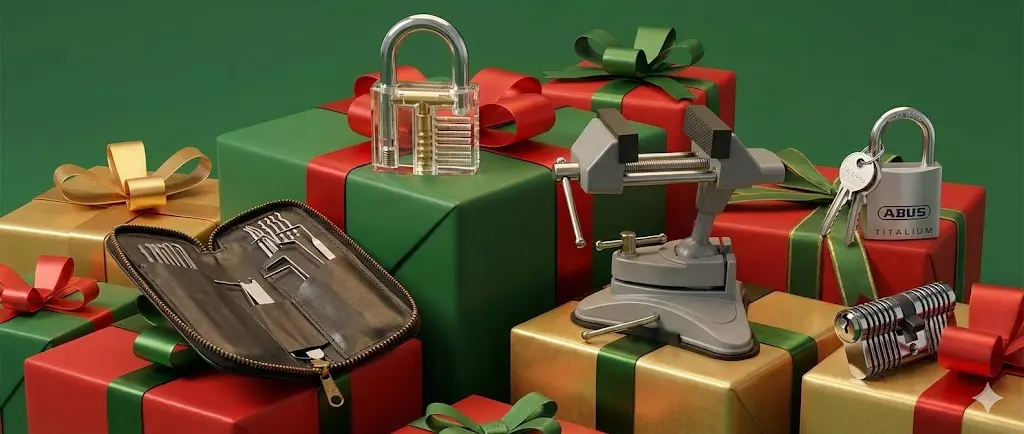
Lockpick Gift Guide Christmas 2025: The Best Gifts for Hobbyists
Looking for the perfect Christmas gift for a lockpick enthusiast? In this guide, I discuss the best lockpick sets and practice locks for both beginners and advanced hobbyists, including...
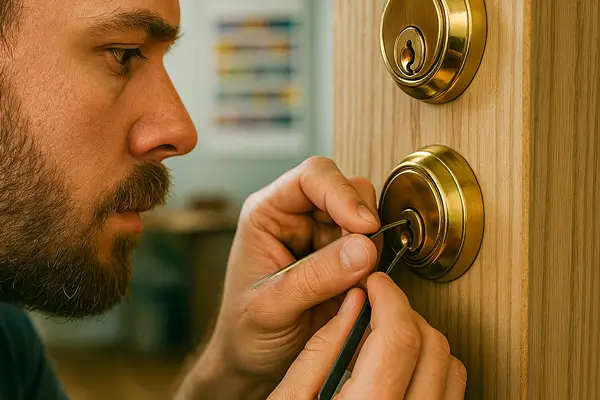
What is Locksport? Guide to Our Hobby and Sport
Discover what locksport is: the popular hobby of opening locks without a key, purely for the challenge. In this comprehensive guide, you will read about the history of lockpicking,...

Geocaching in the Netherlands
Geocaching is a popular outdoor activity where you search for hidden caches using GPS. Discover the history of this hobby, how geocaches work, and how lockpicking sometimes plays a...
How does a Lockpick Gun work?
A lockpick gun (snap gun) uses kinetic energy to separate the pins in a cylinder lock, similar to the Newton's cradle principle. In this article, I explain the physics...