
-
Your shopping cart is empty
Go to the shop to add products to your cart
An Online Lockpick Game!
Play now Shear Line, a free lockpick simulator in your browser with a real pin tumbler lock. Made by a real lockpicker who introduces you to spools and serrated pins. Educational for beginners and fun for advanced users.
Author: Ties
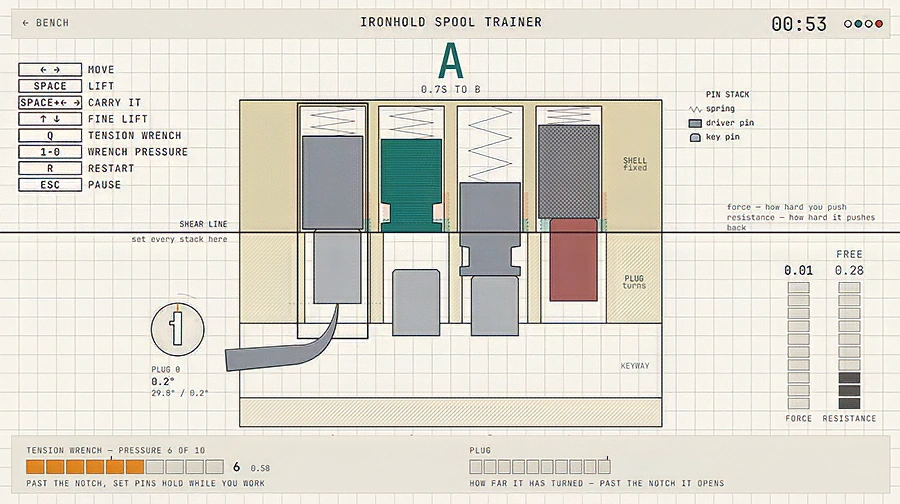
Play directly: Shear Line runs for free in your browser at lockpick.fun. No installation, no account, and once loaded, no requests go online.
Last week I received a message from Steph. He built Shear Line, a lockpick simulator that you can play in your browser or via Steam. He did this because he was tired of how games handle locks. After the Gothic remake, he had enough and decided to do it himself.
And you can tell right away. This was not made by a studio that thought lockpicking was just about a hairpin and a lever. This was made by a lockpicker who knows how a lock behaves and has recreated that.
No dice, just a lock
Most games turn lockpicking into a puzzle. Connecting tubes, rotating a cylinder until your lockpick breaks, or a hidden die decides that you deserve it. Shear Line does not do that.
Here, a real pin tumbler lock is calculated one hundred and twenty times per second. There is no secret success chance and no progress bar. A pin sets because you held your pick still in a window of a fraction of a millimeter, long enough for the edge of the plug to slide under the driver pin.
You see the entire cross-section on screen. At the top are the springs, below that the driver pin, below that the key pin, and running through everything is that one line where the plug meets the shell. As long as there is still a driver pin sticking over, nothing turns.
If you’ve never picked a lock before
What I find so strong about this game is that it teaches you the basics without feeling like learning. At the top of the workbench are three short lessons that take about five minutes in total. No wall of text to click away, just one line at a time that changes as you do something.
Those three lessons are actually the entire craft in miniature. You learn which pin binds, you learn what it costs if you overset one and have to reset, and you meet a spool that lies to you. Whoever understands that understands lockpicking.
The very first thing you learn is the tension wrench, and that is just right. Without tension, nothing binds, and you can push all the pins of the lock up without achieving anything. The game keeps telling you that in orange until you do it right once.
You pick with your keyboard. Holding down Q is your tension wrench, the numbers 1 to 0 are ten steps of wrench pressure from light to heavy, moving left and right along the chambers, and the spacebar lifts your pick. On your phone, you turn the screen sideways, tap a pin, and drag up, with a slide along the left edge as a wrench.
And if you’ve been picking for years
Then this is also a fun lockpick game! There are twenty-two locks divided into four tiers, and the last ones will make you sweat. Additionally, there is a separate category for wheel locks, because yes, you can crack a combination lock in this game, complete with false gates that feel just as deceptive as a spool. You can also do a few mini-games like a maze game with locks and a blitz game.
The pins lie to you
Standard pins bind, set, and then are done with you. A spool has a waist where the plug falls in, causing the cylinder to turn quite a bit and feel exactly like it’s open while you’re nowhere near it.
Furthermore, there are spool-slim, spool-deep, and spool-double, plus serrated pins that lie to you four times in a row on the way up. Mushroom pins punish a heavy hand harder than anything else, as they push your pick out of the lock. The t-pin barely pushes back but allows the plug to turn quite far.
None of those lies are scripted. They just roll out of the shape of the pin, just like in real work. If you still push too hard, your pick bends first and then breaks.
Four levels that only take away what you see
The four levels in the settings do not change the physics; they only take away what you see. In training, you get everything, on easy the hints disappear, on medium the dots per pin, and on hard the cross-section is completely gone. Then you only have the front of the lock and what you hear.
Playing blind is rewarded instead of just admired. The level scales the time against which you are measured, from 0.6x in training to 2.5x on hard. The same run is thus a C on easy and an S on hard, and there is nothing hidden behind the difficulty level.
The labyrinth
Then there is the labyrinth mode, a prison that is reshuffled every run. Every door and every chest is a real lock from the same simulation, and the guards walk by while you are kneeling. There is a guard who closes doors behind him, a watcher who looks ten cells ahead, and a blind listener who hears your footsteps through the walls.
If you break a pick there, everything with ears comes your way. Fighting is not an option; you have two picks, a lamp, and a closed gate on the other side. Additionally, there is an editor that allows you to build locks from one to sixteen chambers, with codes short enough to read over the phone.
Steph also organizes real afternoons
What I might find even more enjoyable than the game itself is what Steph does on the side. He regularly organizes a Social Lockpicking Afternoon, a relaxed gathering of two to three hours in a café or bar near him. No prior knowledge is needed, and an IT background is not required at all.
You get coffee, tools, and your first locks; he shows a few basics, and then you get to work yourself. He consciously ensures that everyone gets their first lock open that afternoon because that feeling is what it’s all about. There are boxes with locks on them containing prizes and tickets, and if you open seven easilocks, you get a badge with a white band.
What I love most is that he doesn’t earn anything from it and doesn’t want to. No disguised marketing, no personal brand, just bringing people together who want to try something new. Photos from previous editions are on his Meetup page.
That aligns perfectly with how we view this hobby. If you want to know more about that community, read what locksport actually is or what TOOOL Netherlands does.
Fun game about lockpicking
The best thing about Shear Line is that you suddenly see concepts like binding, false set, and overset happening. Those are exactly the things you can only feel with a real lock, making them so abstract for beginners. Half an hour of playing and you have the vocabulary that others take months to acquire.
For those who already pick, it works exactly the other way around. You already know how a spool feels in your fingers, but here you see why it behaves that way. Those two images together make you noticeably faster with the real cylinder.
And it costs you nothing to try it. The browser version is free, open source, and runs without installation or an account. If you want it offline, every build is available as a zip at the release on GitHub. Unzip, open index.html, and it runs from your own drive.
Everything is in English, but the game relies mainly on visuals and feel, so it’s easy to read. The Steam version is also coming, with achievements and cloud saves.
This is how I would approach it
First, do those three lessons and the first two locks in your browser; that will take you about fifteen minutes. Then grab a transparent practice lock and lay the same movements side by side. You will notice that the game gives you exactly the words to understand what your hands are doing.
If you want to add the theory, read how lockpicking works and the guide on pin tumbler locks. When you’re ready to try it for real, you need little more than a beginner set with a decent hook pick and a tension wrench that fits your hand.
If you’re further along and want to tackle that hard mode, our tips for single pin picking will help you a lot. I’m curious who will be the first to get an S on the last lock.

More Lockpicking Blogs
Want to learn lockpicking? With the right lockpick set and our guides, you can open your first lock within just a few hours. Whether you choose a beginner lockpicking set or professional lockpick tools, our articles will teach you all the techniques step by step.
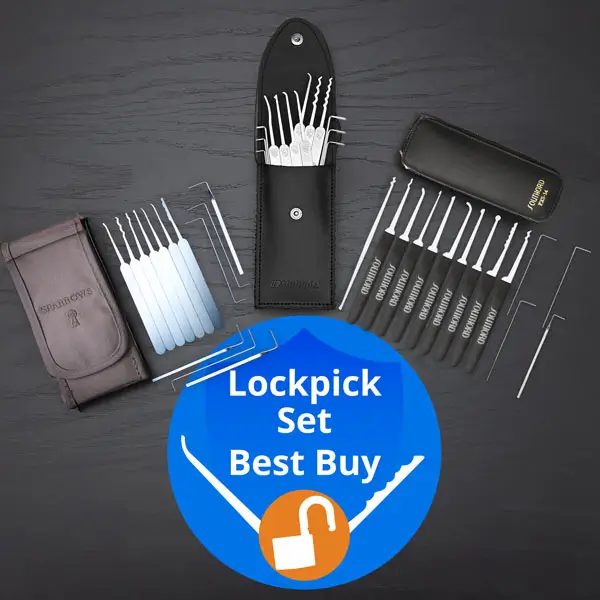
6 Best Lockpick Sets for Beginners [2025 Update]
Which lockpick set is best for beginners? Ties compares six sets based on picks, thickness, and use, and explains what to look for in your first set.
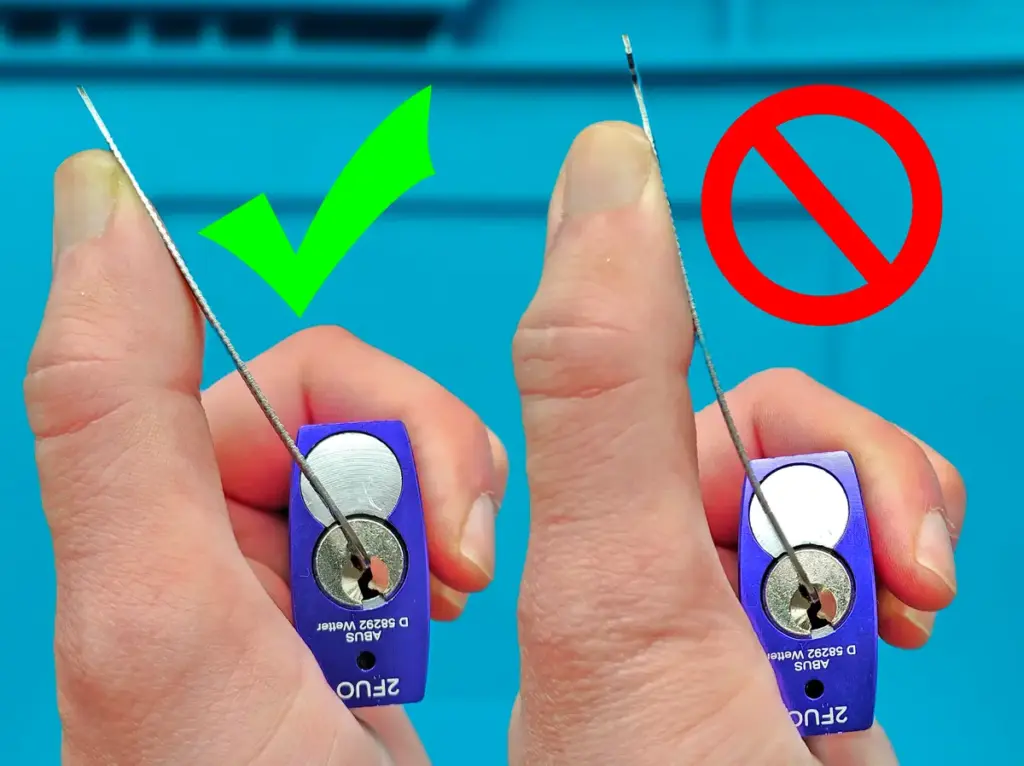
The 10 Most Common Lockpick Mistakes
After years of helping lockpickers, I keep seeing the same mistakes: too much tension on the tension wrench, only practicing with transparent locks, wrong tool choices, and skipping progressive...
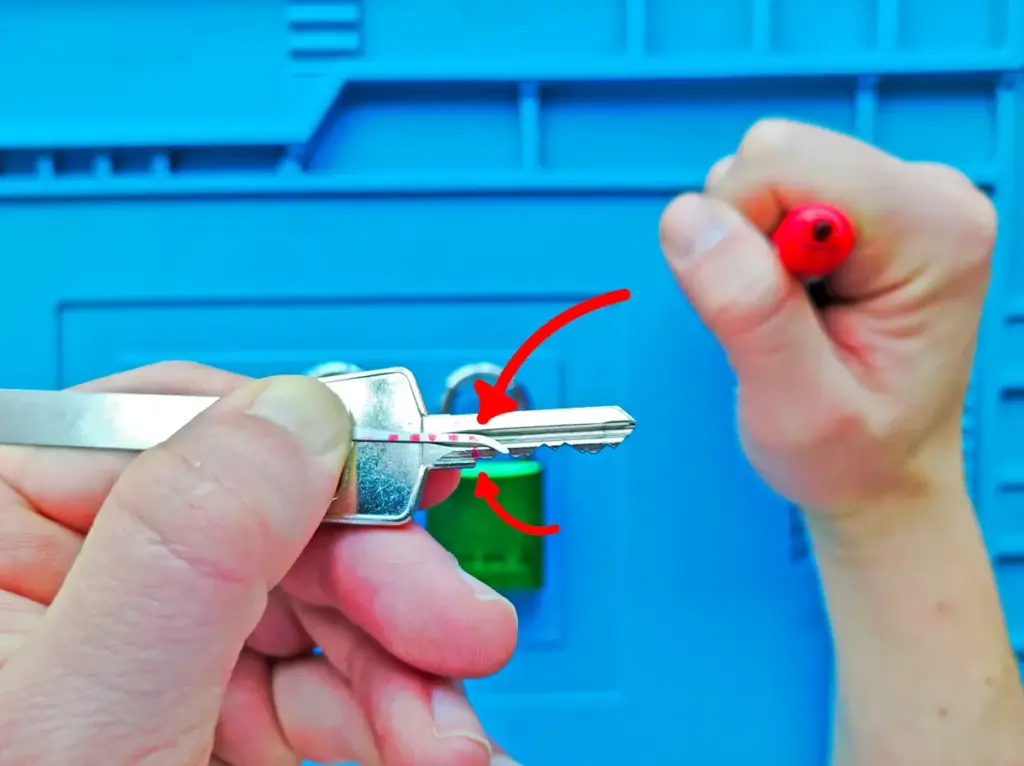
The Marking Technique – Lockpicking for Beginners
Learn how to mark your lockpick with a simple pen to learn lockpicking faster. This life hack gives you visual reference points, so you know exactly how deep to...
Lockpicking and Bumping
Discover how bumping works as a lockpicking technique to open pin tumbler locks. We explain how a bump key functions, which methods such as the Rebound and Micro-Movement methods...