
-
Your shopping cart is empty
Go to the shop to add products to your cart
FEA Analysis GrimGo Lock Pick Designs
A technical research report on the GrimGO prototype phase, in which an FEA analysis (Finite Element Analysis) was conducted on more than 35 lockpick designs. Discover what insights this research provided regarding the strength and durability of the final lockpick set.
Author: Ties
🕐 Reading time: 8 minutes
Technical Research Report – Prototype Phase
We conducted FEA analysis (Finite Element Analysis – a computer simulation for measuring structural loads) on more than 35 lock pick designs, including existing models from Peterson and Covert Instruments. The data has resulted in a prototype now ready for field testing. This report presents measurement results without interpretation.
Table of Contents
- Methodology and Test Parameters
- Comparative Measurement Data of Existing Designs
- Prototype Specifications and Geometry
- Von Mises Stress Distribution
- 410 Stainless Steel Properties
- Early Adopter Testing Program
- Terms and Expectations
Methodology and Test Parameters
The FEA analysis was executed according to standardized parameters to enable comparable measurements between different designs. This eliminates variables commonly encountered in empirical testing—human error, inconsistent force application, and environmental factors that typically corrupt experimental data.
Standardized Test Conditions
- Applied force: 8.9 Newton (2 lbf)
- Contact surface: 2mm² at tip
- Resulting pressure: 4.45 MPa
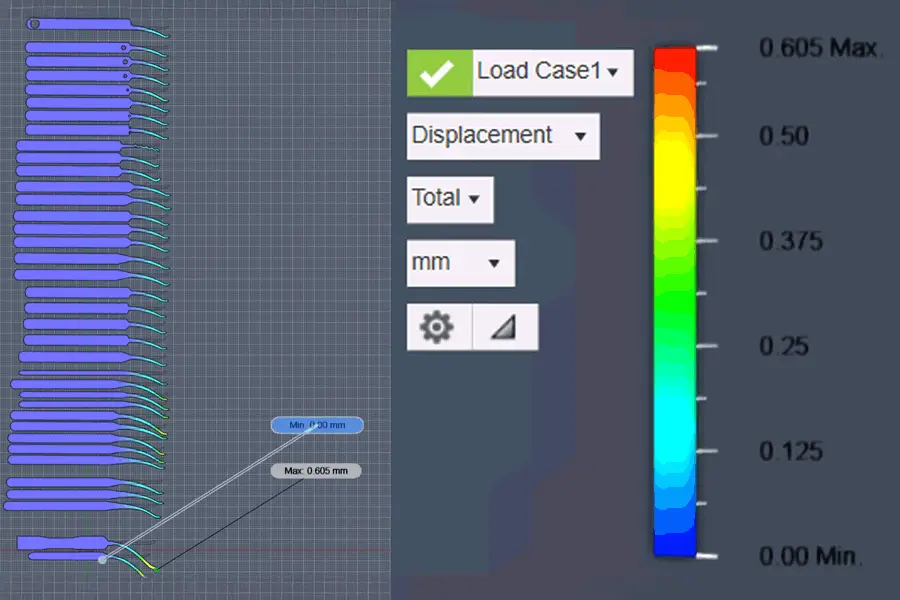
Overview of 35 analyzed designs. Color scale: 0mm (blue) to 0.605mm (red) maximum displacement under standard load. The color gradient proves remarkably effective at revealing which designs exhibit concerning structural compliance.
Practical translation: We subjected all picks to identical computational loading and measured deflection under stress. Reduced deflection correlates with improved tactile feedback during pin manipulation—a relationship that becomes self-evident once one comprehends basic beam mechanics.
The test methodology follows recommendations from Christina Palmer’s metallurgical research on elvencraft.com. All designs were tested with identical boundary conditions to ensure direct comparability. Any deviations would render the comparison meaningless, though this should be obvious to anyone familiar with basic experimental design.
Comparative Measurement Data of Existing Designs
Three designs were selected for direct comparison: the new prototype, the APEX Hook Pick (Covert Instruments), and the Peterson H1. This selection is based on comparable geometrical profiles, though their performance characteristics diverge significantly—as the data will demonstrate with clinical precision.
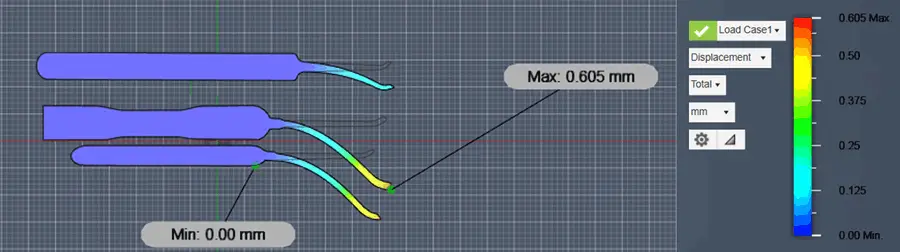
Top: Prototype design. Middle: APEX Hook Pick. Bottom: Peterson H1. All subjected to 8.9N loading. The color gradient reveals structural behavior with unambiguous clarity.
| Design | Max. Deflection (mm) | Relative Stiffness | Observation |
|---|---|---|---|
| Prototype | 0.217 | 100% (reference) | 32mm effective shaft |
| APEX Hook | 0.605 | 36% | Extended shaft length |
| Peterson H1 | 0.591 | 37% | Standard profile |
Measurement notation:
1. The APEX exhibits 2.79× greater deflection than the prototype. This is primarily attributable to extended effective shaft length—a variable that manufacturers apparently overlooked during their design phase.
2. Covert Instruments, to our knowledge, does not utilize 400-series stainless steel as Peterson and GrimGo do. In our analysis, we assigned identical material properties to all tools since our focus was exclusively on geometric design efficiency. This standardization reveals that geometry, not merely material selection, determines structural performance.
In unambiguous terms: The prototype deflects 2.79 times less than comparative models under identical loading. This translates to superior tactile feedback during pin manipulation—a correlation that should require no further elaboration for practitioners familiar with single-pin picking methodology.
Prototype Specifications and Geometry
The prototype incorporates three geometric characteristics that correlate with reduced deflection in FEA analysis. These are not arbitrary design choices but rather optimizations derived from computational analysis:
Reduced shaft length: 32mm effective (measured from first support point to tip)
Progressive taper: Linear reduction from handle thickness to 2mm tip
Smooth transitions: Absence of abrupt diameter changes in stress zones
The latter point merits emphasis: abrupt geometry changes create stress concentration points—failure initiation sites that compromise structural integrity. This is elementary mechanical engineering, yet many commercial designs exhibit precisely this flaw.
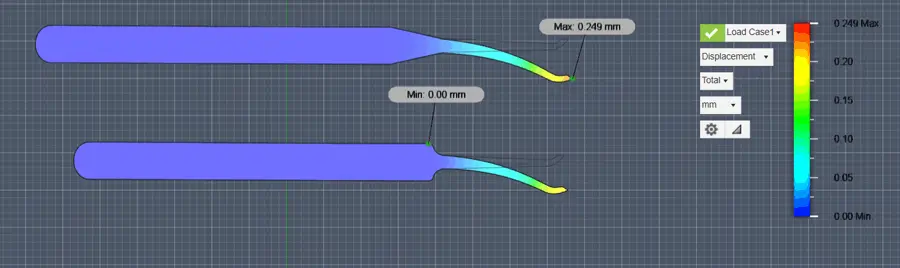
Upper design: 0.249mm deflection (slightly extended shaft for testing purposes). Lower: final prototype profile with 0.217mm deflection. The improvement is modest but measurable.
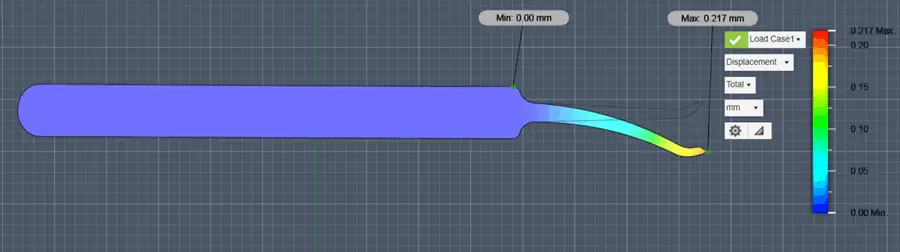
Final prototype design. Maximum deflection: 0.217mm under standard loading. This is the geometry now entering production for field testing. Whether it performs as predicted remains to be empirically validated.
Von Mises Stress Distribution
Von Mises stress analysis identifies potential failure points in the design with computational precision. This data proves relevant for life expectancy prediction under cyclic loading—assuming, of course, that users apply consistent technique, which field experience suggests is optimistic.
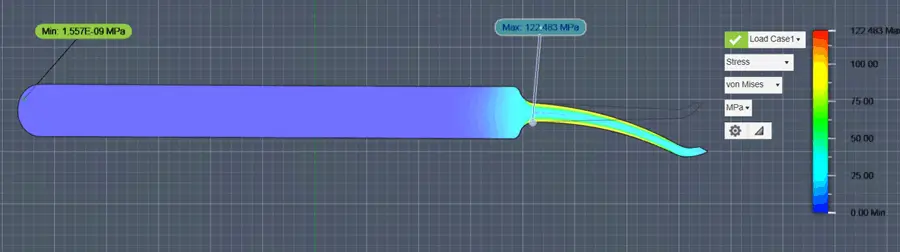
Stress distribution reveals maximum of 122.5 MPa at shaft-tip transition. This is the zone that will first exhibit plastic deformation under overload conditions. Users who apply excessive force will discover this empirically.
Measured Stress Values
- Maximum stress: 122.483 MPa (transition zone)
Critical notation: These values represent computational simulations. Field testing must validate whether predicted service life aligns with actual usage patterns. Variables including surface finish, microcracking, and user technique can deviate significantly from idealized simulation conditions. In other words: reality tends to introduce complications that computers optimistically ignore.
410 Stainless Steel Properties
The prototype utilizes 410 stainless steel in 0.5mm thickness. This is a martensitic stainless steel alloy frequently employed in medical instruments and precision tooling—applications where dimensional stability under stress proves non-negotiable.
| Property | 410 SS (prototype) | 301 Full Hard (reference) | Difference |
|---|---|---|---|
| Yield Strength | 221 ksi (1524 MPa) | 140 ksi (965 MPa) | +58% |
| Hardness (Rockwell C) | 42-52 HRC | ~41 HRC | +2-27% |
| E-modulus | 200 GPa | 193 GPa | +3.6% |
| Density | 7.8 g/cm³ | 7.9 g/cm³ | -1.3% |
Practical interpretation: 410 stainless steel exhibits superior hardness and resistance compared to standard austenitic grades. The pick maintains dimensional stability more effectively and resists permanent deformation. Whether users can perceive this difference during operation remains to be determined through field testing.
Material selection was primarily dictated by availability in 0.5mm thickness from our supplier. The elevated carbon content (0.15% C minimum) enables heat treatment to achieve higher hardness than austenitic grades—a metallurgical advantage that translates directly to improved performance characteristics.
Early Adopter Testing Program
The prototype is production-ready but unpolished. All picks exhibit visible production markings, inconsistent surface finish, and have not undergone extensive field validation. This is prototype testing, not retail product distribution—a distinction that should be self-evident but will be explicitly stated nonetheless.
Prototype Testing Program – Terms
Status: Unpolished prototype, batch 1/1
Available: 100 units (4-pick sets)
Price: €15.00
Contents:
- 1× Standard Hook (0.5mm 410 SS)
- 1× Medium Hook (0.5mm 410 SS)
- 1× Large Hook (0.5mm 410 SS)
- 1× Triple Peak Rake (0.5mm 410 SS)
- 3× TOK Tension Wrenches (standard grade)
- 3× BOK Tension Wrenches (standard grade)
Refund Structure:
Upon purchase of this prototype, you receive a discount code valued at €15.00. This code is exclusively valid for the definitive version when available (anticipated date: Q1 2026). The code is single-use and expires 6 months after definitive version release.
Practical terms: You pay €15.00 now for the prototype. When the definitive version launches (price to be determined, estimated €25-35), you may order it and receive €15.00 discount via the provided code. This effectively functions as a zero-cost prototype evaluation for committed testers.
Check Availability
Terms and Expectations
Read This Carefully Before Purchase
This is a prototype. Expect the following limitations—which are inherent to prototype testing and should surprise no one familiar with product development cycles:
- Surface quality: Visible grinding marks, oxidation spots, inconsistent finish
- No warranty: Prototypes carry no standard warranty. Defects are assessed case-by-case
- Geometric variation: ±0.1mm tolerance on critical dimensions possible
- Packaging: Basic plastic bag, no retail packaging
- Documentation: No manual, tutorials, or support materials included
- Delivery time: 1 day. Ordered before 23:30, delivered tomorrow.
Suitable for: Experienced and inexperienced lock pickers willing to provide technical feedback on pick performance. The set is designed as a first pick set for beginners—though whether beginners can provide technically meaningful feedback remains an open question.
Feedback Methodology
Early adopters may utilize a feedback form. This contains specific questions for set evaluation. Feedback is not mandatory but is valued for design iteration—though statistically, voluntary feedback rates typically hover around 15-20%, which will limit data robustness.
Download the form here:
Download GRIMGO Feedback Survey (312 KB)
Definitive Version Expectations
The definitive version will differ from this prototype in the following aspects:
- Polished surface finish (tumbled)
- Handle option (rubber, heat-shrink, or bare)
- Proper storage case
- Possible geometry adjustments based on feedback
- Standard warranty terms
Timeline: No fixed date. The definitive version becomes available when:
Minimum 50 feedback forms have been received
Identified design issues have been addressed
Production process is validated for consistent quality
This is dependent on user participation—a variable that, historically, proves unreliable.
Data Sources and Methodology References
This research is based on the following public sources:
- Christina Palmer – Lock Pick Recommendations (FEA methodology)
- Christina Palmer – Lock Pick Metallurgy (material properties)
- Material datasheets 410 Stainless Steel (various suppliers)
- Standard FEA procedures for cantilever beam analysis
All measurements are exclusively simulation data. Field tests are ongoing but not yet available in sufficient quantity for statistical analysis. Computational predictions await empirical validation—as they always do.
Contact and Inquiries
For technical questions regarding FEA methodology, material specifications, or the testing program: Customer Service
Technical Summary for the Time-Constrained Reader:
We subjected 35 lock pick designs to computational analysis. Our prototype exhibits 2.79× less deflection under loading than standard commercial models. This correlates with improved tactile feedback during manipulation. Material (410 stainless steel) demonstrates superior hardness compared to typical austenitic grades.
You may purchase the unpolished prototype for €15.00 and receive a €15.00 discount code upon release of the definitive version (Q1 2026). The prototype carries no warranty and exhibits visible production artifacts, but remains fully functional for its intended purpose.
The set contains 4 picks + 6 tension tools and is suitable for both beginners and advanced practitioners. Feedback is appreciated but not mandatory—though without adequate feedback, design iteration becomes problematic. This should be self-evident.

More Lockpicking Blogs
Want to learn lockpicking? With the right lockpick set and our guides, you can open your first lock within just a few hours. Whether you choose a beginner lockpicking set or professional lockpick tools, our articles will teach you all the techniques step by step.
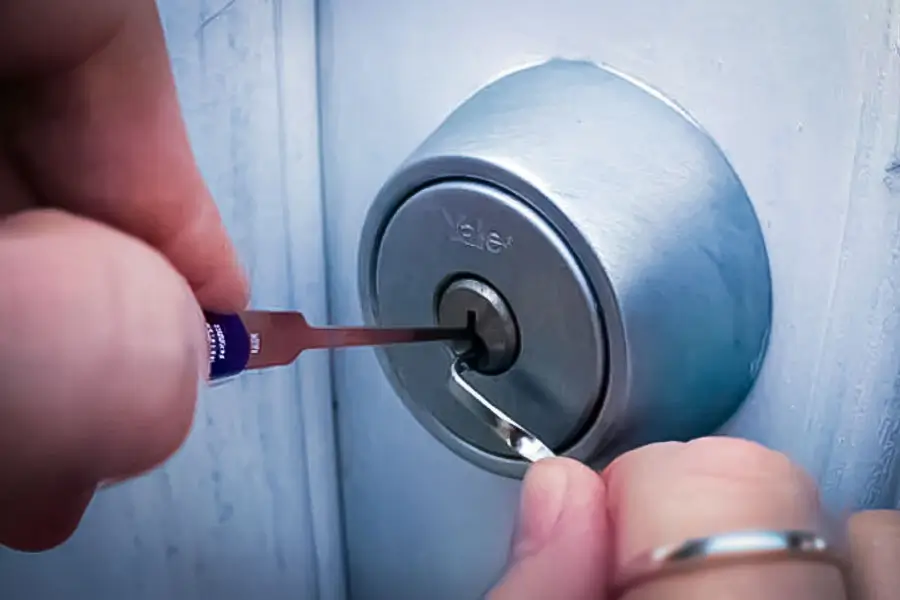
Why You Should Learn Lockpicking Now
Lockpicking has an undeserved negative image, but it is primarily a valuable and fascinating skill. Discover how it helps you better understand your own security, how it provides solutions...
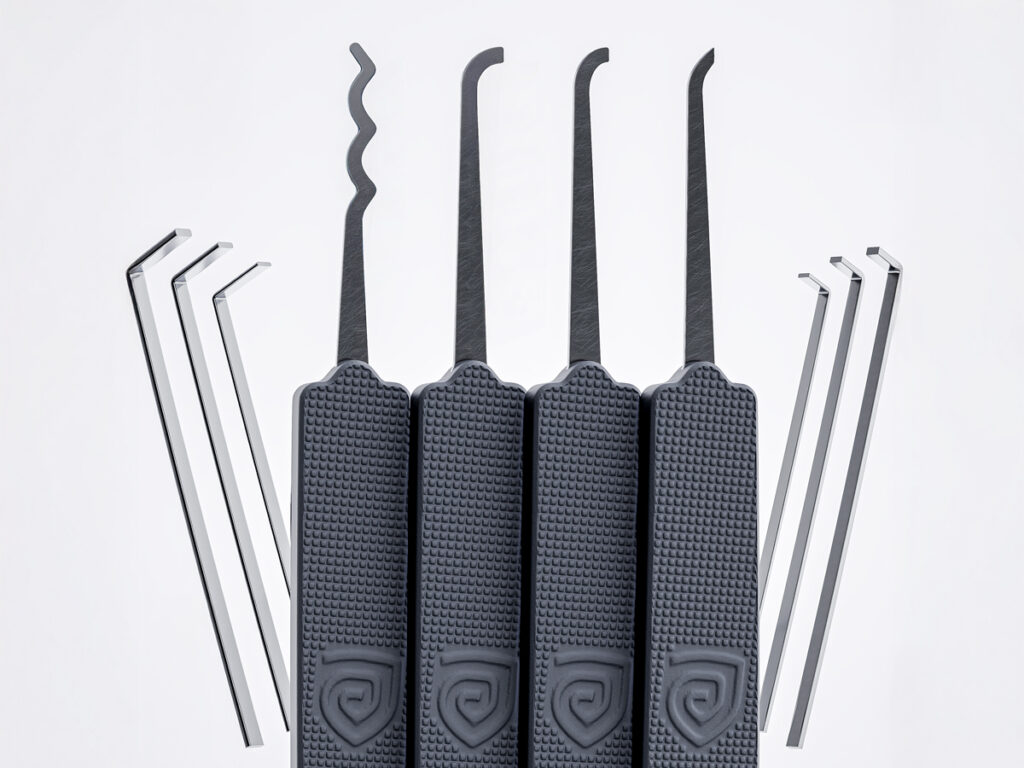
GrimGo Lockpick Set: First Feedback
The first GrimGo lockpick sets have been delivered and user feedback is pouring in. In this article, I share the initial experiences, why this set was developed to prevent...
Opening a Padlock with a Belt
A simple belt turned out to be enough to open a padlock, as a surprising video shows. This story illustrates how creativity can solve a problem without special tools...

Why is lockpicking so popular?
Lockpicking has evolved into a popular sport where you challenge yourself with locks. Discover why more and more people are taking up lockpicking, what the main principles are, and...